Welcome To Low Vision Now!
Who are We?
Formerly known as the Delaware Valley Council of Citizens with Low Vision. We are an affiliate of the Council of Citizens with Low Vision International as well as the American Council of the Blind.
Low Vision Now is a group with a mission to empower people with education, resources, support, and advocacy related to Low Vision.
Contact Us
Our Phone Number:
Join Us In Our Monthly Zoom Meetings.
We meet each month by Zoom. Usually, it is the first Saturday of the month. Our meetings begin between 12:45 pm and 12:55 pm EST. They last around 1 hour 45mins with the last half hour dedicated for new participants and/or people with new vision losses to have an opportunity to talk.
What do we talk about during our Zoom Meetings? We discuss and help each other with ways to do things with low or no vision. Some things which have been brought up several times is the problem people have with:
- The lighting in their home.
- Seeing objects, such as a chair, couch, edge of wall, light switches, doors and doorways,
- Spilling liquid when pouring it into a glass, bottle, or pot.
- Seeing the colors of clothes.
- Reading newspapers, books, mail and other print in life.
- Shopping for food and other supplies.
- Using a cell phone.
- Crossing streets.
- Going out to dinner and seeing the menu, plate, utensils, glasses and which food is where.
- Identifying people’s faces in a room.
- Telling people help is needed to find things or go places.
- Seeing TV shows or movies.
- Cooking and preparing food.
To listen to recordings of some of our meetings, click Button below:
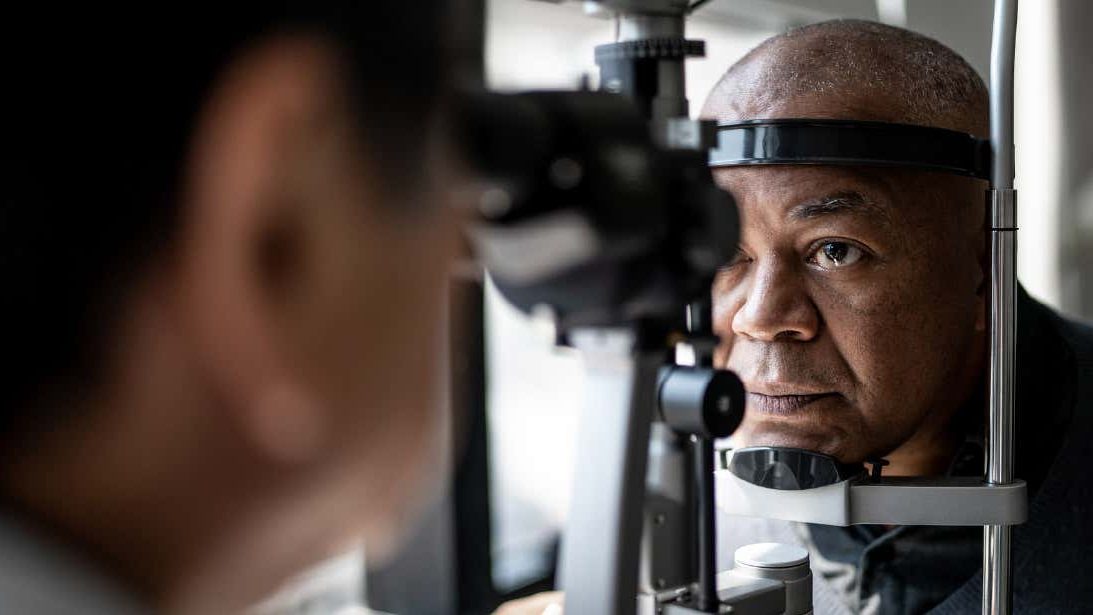
Low Vision is characterized in many different waves. The one most used definition is having a visual impairment which cannot be corrected by eyeglasses or a contact lens. It is when someone has difficulties doing one or more tasks of daily living due to reduced sight. Low vision may occur any time during a person’s life or have existed from birth. The best acuity people with low vision have is 20/70 or a substantial loss of field of vision. Such field of vision losses can be due to Glaucoma, Blind Spots, Retinitis Pigmentosa. usually referred to as Tunnel Vision, and other such conditions.

How is Acuity, Field of vision, 20/20, 20/70, 20/200 and 30 degrees of vision Simply defined?
Acuity is our ability to see details.
20/20 is Full vision and refers to someone at 20 feet seeing the same things as the fully sighted .
20/70, means that you need to be 20 feet away to see what fully sighted people see at 70 feet.
20/200, means that what you see at 20 feet, fully sighted people see at 200 feet.

Field of vision refers to your total field of view. Fully sighted people have 180 degrees field of vision using both eyes. Someone with 30 degrees field of vision only see 30 degrees of the 180 degrees field of sight.
Something to know, our Ability to see is not confined to how our eyes work. To see our body uses our eyes as well as the optic nerve and the brain.
If you are asking why you should attend and/or join Low Vision Now, here are some reasons why:
- You will no longer be alone as you face your loss of vision.
- You will meet people like you who are not totally blind nor fully sighted.
- You can ask other people who have your eye condition how they are handling things.
- You can talk with people whose vision is stable and also to those whose vision keeps changing.
- You can share problems you have in doing things and see if anyone has ways to do them without full sight.
- You can share stories of situations you experienced due to your low vision.
- You can ask other members for ways they tell people they can’t see things and need help.
- You can talk about ways the people in your life deal with your low vision.
- You can get support from other members between meetings.
- You can hear presentations relating to the lives of people with low vision.
- You can help others who are newly visually impaired.
- You can get a better understanding of your family member’s, friend’s, and client’s life with low vision.Those are but a few reasons and by attending, you will find even more reasons to join.
Those are but a few reasons and by attending, you will find even more reasons to join.
 lowvisionnow.org